
Psilotum
By Dr. Rimi Roy (Assistant Professor of Botany, Academic Contributor)
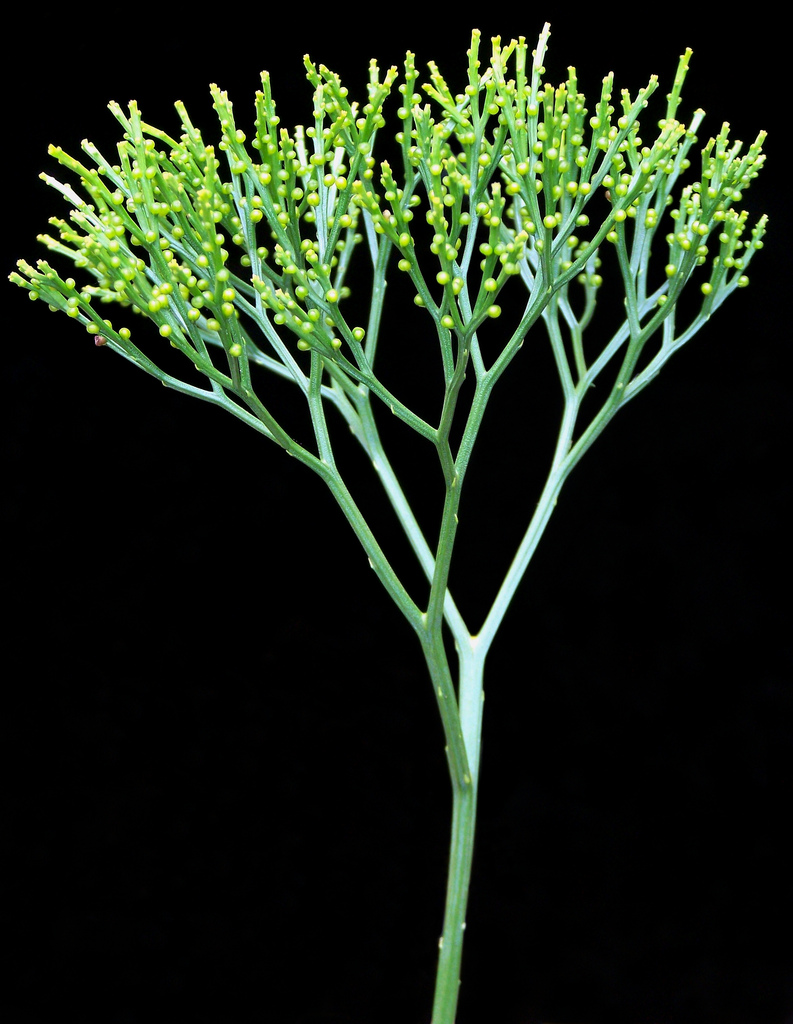
- Also known as WHISK FERNS.
- Vascularized member of genus fern.
- A member of family Psilotaceae.
- Lack true root (but Rhizomes) and leaves but stems (branched spore bearing) are developed with conducting tissues.
- Only two pure species of Psilotum exist along with a hybrid between these two.
- Gametophytes are underground saprophytic, sometimes even mycorrhizal.
- Nutrition of gametophyte is Myco-heterotrophic assisted by endosymbiotic fungi.
Salient Features of Psilotum
- The sporophytes are dichotomously bran-ched with an underground rhizome and upright branches.
- The upright branches are leafless.
- Rhizoids present instead of roots.
- Stem have a relatively simple vascular cylinder.
- The sporangia are borne in groups (trilocular) and form synangia.
- Spores produced are all alike (homosporous).
- The development of gametophyte is exosporic and form monoecious subterranean gametophyte.
- The development of embryo is exoscopic.
Systematic position
•According to Smith et al (2008) the single family Psilotaceae is placed under the order
•Psilotales in the Class Psilopsida as follows:
Division: Pterophyta
Class Psilotopsida
Order: Psilotales
Family: Psilotaceae
•The family includes two genera: Psilotum (2 species) and Tmesipteris (10 species)
Occurrence

- The genus Psilotum (also known as whisk fern) is represented by only two species – P. nudum (P. triquertum) and P. flaccidum (P. complanatum).
- It is commonly found throughout the tropical and subtropical regions of the world including India.
- It grows as epiphyte as well as terrestrial on rock crevices.
- In India, P. nudum (L.) Beauv is found in Pachmarhi hills, Kullu, West Bengal, Assam and some places of South India (Karnataka).
- P. flaccidum differs from P. nudum in possessing Pendent flattened stem. It is reported from tropical islands like Jamaica, Java etc., besides the Malayan peninsula and Mexico.
MORPHOLOGY
- The plant body of Psilotum is differentiated into two parts viz., a horizontal underground rhizome and an erect aerial shoot.
- The rhizome is brownish in colour and dichotomously branched. There are no roots. The rhizome is studded with a number of long, fine, thread like rhizoids.
- Some of the branches of the rhizome grow up and constitute the erect (P. nudum) or pendulous (P. flaccidum) shoot system. The aerial shoots are 20-75 cm long and are usually ribbed and multi-angular. The ultimate branches however are triquertous.
- In P. flaccidum the base of the aerial shoot is triquertous while the tips are flattened.
- The aerial shoots are regularly dichotomously branched and are deep green in color indicating their photosynthetic activity.
- On the aerial shoot are found a number of scales or appendages which are often called leaves. These are of two types viz., sterile and fertile.
- The sterile ones are found all along the length of the aerial shoot while the fertile ones are generally restricted to the upper portions and bear in their axils a trilobed spore bearing structure which is often called a Synangium.
- The leaves whether fertile or sterile are devoid of any vasculature and could be regarded as only emergences.
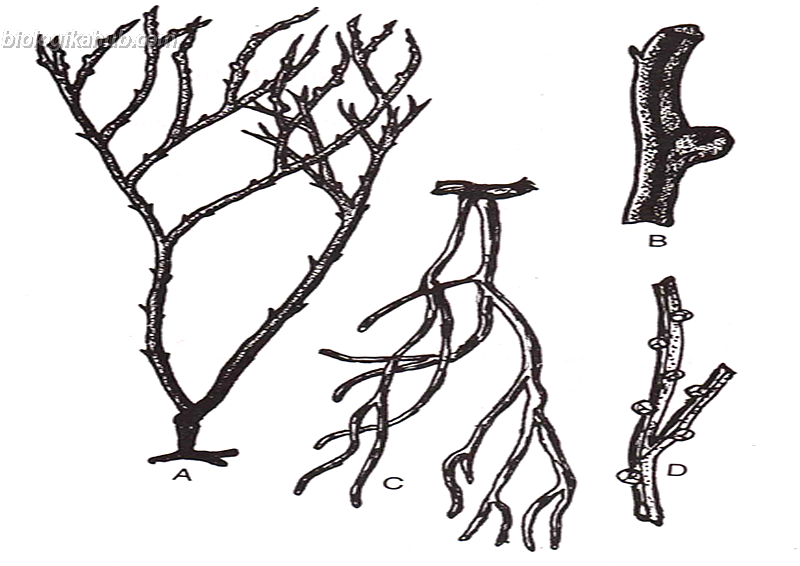
Anatomy

(B) A part of stem bearing Synangia.
- 1. Aerial shoot:
- A transverse section of the stem shows three regions, viz., epidermis, cortex and stele. Epidermis is single layered and has closely packed cells. The layer is discontinuous due to the presence of stomata. The stomata are restricted to grooves between the longitudinal ridges and are sunken in nature. Above the epidermis there is a thick cuticle.
- The cortex is divided into three zones. The outer zone is chlorenchymatous and is made up of 2-5 layers of cells. The cells are loosely arranged with intercellular spaces. As the leaves are reduced, this constitutes the chief photosynthetic tissue of the plant.
- The presence of thick cuticle, sunken stomata, photosynthetic stem and reduced leaves indicate the xerophytic nature of Psilotum.
- The middle region of cortex consists of 4-5 layers of sclerenchyma offering mechanical support to the stem.
- The inner cortex is made up of a few layers of closely packed parenchyma cells.
-
- The stele occupies the central region of the stem.
- The outermost layer of the stele is endodermis.
- Next to the endodermis is an ill defined pericycle.
- The nature of the stele varies in the ultimate branches and in the basal portion.
- In the ultimate branches the stele is an actinostelic protostele with a solid core of stellate xylem mass in the centre.
- In the basal portion however, the central region of the stele consists of a sclerotic pith.
- The xylem is exarch with the protoxylem points located at the tips of the rays. The xylem consists of scalariform pitted or annular tracheids. Sometimes spiral tracheids are also found. Surrounding the xylem is the phloem.
- The stele occupies the central region of the stem.

- 2. Rhizome:
- This also shows an epidermis, a cortex and stele. The epidermis is ill defined.
- The cortex is divided into three zones. The outer cortex is parenchymatous and the cells have mycorrhizal fungus. The middle cortex has parenchyma cells rich in starch grains. The innermost region of the cortex also consists of parenchyma that are usually dark brown in color due to the deposition of a substance called phlobaphene. This is believed to be an oxidation product of tannins.
- The stele is protostelic and is surrounded by a typical endodermis which is followed by a layer of pericycle. The xylem is exarch and is surrounded by phloem

- 3. Leaf:
- The leaves show epidermis and the mesophyll.
- The epidermal cells are cutinised. The mesophyll has chlorophyllous cells which may be loosely or closely packed. The stomata are absent in the epidermis.
- There is no vascular supply to the leaf. But in P. flaccidum a leaf trace which starts from the stem terminates at the leaf base.
- The absence of stomata and the lack of vascular supply make the chlorophyllous cells of the leaf ineffective in photosynthesis.
Reproduction
- 1. Vegetative Propagation:
- The sporophyte increases its number by the production of gemmae or brood bodies.
- These are formed on the rhizome and are usually restricted to the tips or the axils between the branches.
- Each gemmae is an oval body, one cell in thickness having an apical cell with two cutting faces.
- The cells are rich in reserve food especially starch.
- The gemmae detach from the plant body germinate and give rise to a new plant of Psilotum.
2. Spore Production:
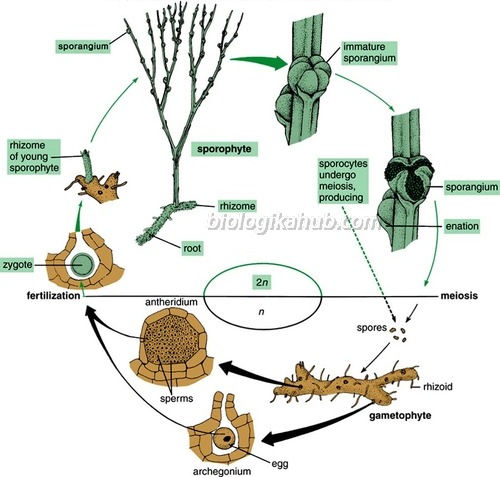
• The sporophyte reproduces by the formation of spores. Spores are produced in special trilobed structures called synangia which are generally restricted to the upper portions of the aerial shoots where they are borne in the axils of minute bifid scales.
- Development of the Synangium:
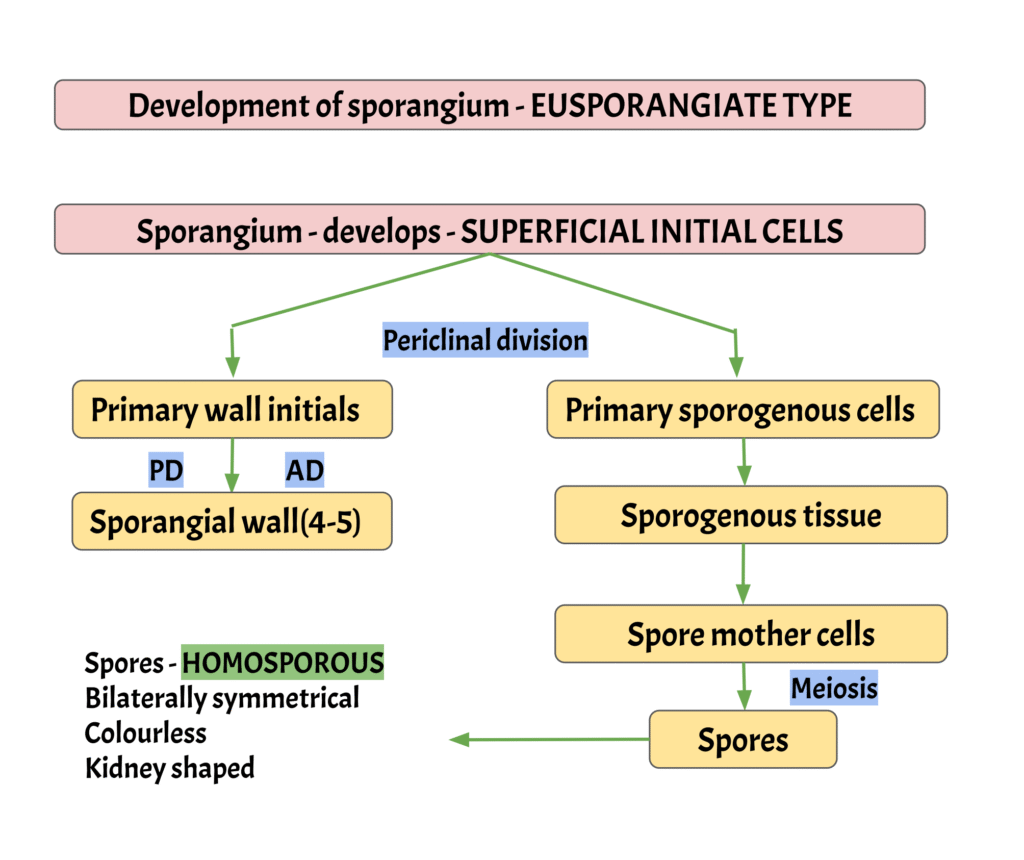
- The synangium (fused sporangia) develops from a group of initials (eusporangiate type).
- According to Bower (1935), the sporangium arises as an outgrowth on the adaxial side of the bilobed appendage. However Bierhost (1956) stated that the sporangium arises earlier than the bilobed appendage. Each lateral outgrowths, grows by means of an apical cell to form a short multicellular fertile axis (stalk of sporangium). Three separate surface initials make their appearance at the stalks. These initials form 3 to 4 layered wall and sporogeneous cells of the sporangium.
- Sporogenous cells after mitotic divisions develop into spore mother cells and later undergo meiosis to produce spores .
- The synangium splits along three longitudinal lines of dehiscence passing through the median line of each sporangium lobe and results spore dispersal.
- Structure of the Mature Synangium:
- The wall of the trilobed synangium is made up of 4-5 layers of cells. The outermost layer of the wall is prismatic. Within the synangium there are three chambers of spore cavities containing spores. All the spores are of the same type.
- Dehiscence of the Synangium:
- When the spore mother cells are undergoing reduction division some of the wall cells thicken except in a small vertical row marking the future line of dehiscence. The synangium splits open along this line liberating the spores.

Gametophyte of Psilotum
- Germination starts after four months on placing the spores on a suitable substratum.
- The first sign of germination is the splitting of the outer spore wall and the projection of a small tubular outgrowth.
- Later a cross wall cuts off the outgrowth from the remainder of the spore. In this way two cells are formed.
- Of the two cells, the upper by further divisions establishes an apical cell which produces a mass of tissue. Early in the development, the ametophyte gets infected by the fungus.
Mature Gametophyte:
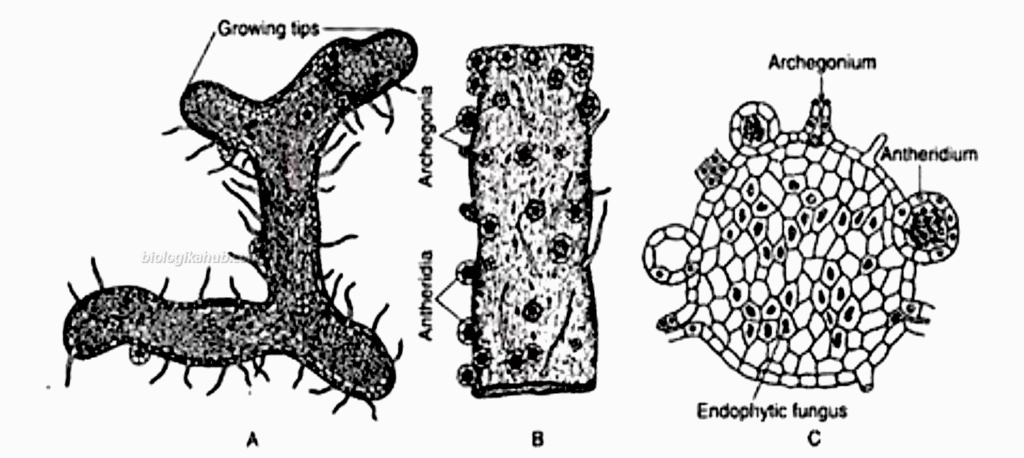
- Structure of the Mature Gametophyte:
- The gametophyte is partly or totally subterranean. It is usually cylindrical in shape with dichotomous branches. The branching however need not be always
dichotomous. In size, the gametophyte ranges from 0.5 to 2 mm. The colour of the gametophyte is sually dark brown. This is due to the presence of endophytic
fungus. - The gametophyte is wholly parenchymatous with strongly cutinised cell walls. The outermost layer of the cells gives rise to a number of rhizoids. In the hypodermal region the cells have the endophytic fungus. According to Beirhorst (1953) the fungus is probably Cladochytrium tmesepteridis. The cells are achlorophyllous and the nutrition of the gametophyte is saprophytic.
- The gametophyte is partly or totally subterranean. It is usually cylindrical in shape with dichotomous branches. The branching however need not be always
- The gametophyte reproduces by two methods
- (1) Vegetative propagation and
- (2) Sexual reproduction.
- (1) Vegetative Propagation:
- Holloway (1939) and Bierhorst (1953) have described the production of gemmae on the surface of the gametophyte. The gemmae arise as proliferations from a rhizoid like structure and are similar to those produced on the rhizome.
- A mature gemmae has 8-12 cells., usually spheroidal or occasionally flattened and on germination gives rise to a new gametophyte.
- 2) Sexual Reproduction:
- This is brought by the formation of antheridia (male) and archegonia (female). The gametophytes are monoecious.
- A mature antheridium is somewhat spherical in shape and projects out of the gametophyte as a hemispherical protruberance. The jacket is made up of about 12 cells and has a special cell called the opercular cell which degenerates at maturity allowing for the liberation of the antherozoids. Approximately about 250 antherozoids are found inside the antheridium.
- The archegonium is embedded in the gametophytic tissue. Nearly mature archegonium consists of a protruding neck, of 4-6 tiers of four cells. The neck encloses 1-2 neck canal cells and the basal broad portion contains, single ventral canal cell and an egg.
- Fertilization:
The antherozoids come out of the antheridium through the passage formed by disintegration of the opercular cells. They swim in a thin film of moisture, approach the archegonium, enter into it and fertilize the egg.
Morphology of the Spore Bearing organs
- There are mainly three view-points:
- 1. The spore bearing complex is a short lateral shoot. This view is supported by Juranyi, Strassburger and Goebel. According to this view there is a short branch which bears two sterile appendages (which develop into the bifid scales) and terminates in the sporangium. This view holds that the sporangium is cauline.
- 2. According to Solms-Laubach (1884), Velenovsky, Seward (1910), Schoute (1938) and Bower (1908) the spore bearing complex is foliar in origin. In other words the bifid appendage arises first on the stem and is comparable to the sporophyll. Later the spore- bearing structure arises on this.
- 3. There is also a third view which regards the spore bearing complex as an organ sui generis. An organ suigeneris is an organ of a special kind which cannot be compared to any other organ. The nature of the trilobed sporangium is also controversial. It is not certain whether it is a single sporangium having three chambers or a synangium formed by the fusion of three individual sporangia. Some of the developmental stages indicate that each ‘locule’ of the sporangium arises from a separate initial cell, thus giving support to the view that it is a synangium.
Phylogeny of Psilotum
- Psilotopsida represents perhaps the most primitive of the extant pteridophytes. Among the living pteridophytes they possess the simplest plant body that could be imagined for a vascular plant. There is no trace of leaf or root. Photosynthesis is carried out chiefly by the main axis.
- Psilotales show close resemblance to the psilophytales than to any other group of pteridophytes. This close relationship has been advocated by Kidston and Lang, Holloway, Bower and others. Arber (1921) suggested that the group psilotales might have originated from algae.
- The points of resemblance between psilophytales and psilotales rest mainly on the following:
- 1. Absence of roots
- 2. Dichotomously branched rhizome with aerial photosynthetic axis
- 3. Reduced leaves
- 4. Relatively simple vasculature
- 5. Cauline sporangia
- Lawson (1917) believes that psilotales have affinities with sphenophyllales but there are certain major differences between these groups, specially in the leaves which rules out any close relationship. Apart from the psilophytales, the nearest relatives of psilotales could be found in the group lycopods. But even here one has to concede the existence of certain important differences. Arber, Thoday etc., regard that psilotales are distinct from lycopods.
- Even Eames (1964) believes that the grouping of psilotales with lycopodiales is unnatural because not only are the psilotaceae leafless and rootless and their sporangia cauline and terminal but also the sperms are multi-ciliate and the antheridia superficial.
- The current thinking regarding the phylogeny of psilotales is that they originated from psilophytales which in turn took their origin from the green algae. Fuller and Tippo (1911) regard that the psilotales are the last living descendants of psilophytales. Through the ages they have persisted braving the vagaries of the environment and have remained unchanged.