METABOLISM DUMP
📚Comprehensive Notes on Glycolysis: Class-I
🔬 What is Glycolysis?
Definition: A universal metabolic pathway that breaks down 1 molecule of glucose (6C) into 2 molecules of pyruvate (3C each).
Cellular Location: Occurs in the cytosol of all living cells.
Biological Role: Primary pathway for ATP production in anaerobic and aerobic conditions. Provides metabolic intermediates for biosynthetic pathways.
⚡ Phases of Glycolysis
🏗️Preparatory (Investment) Phase
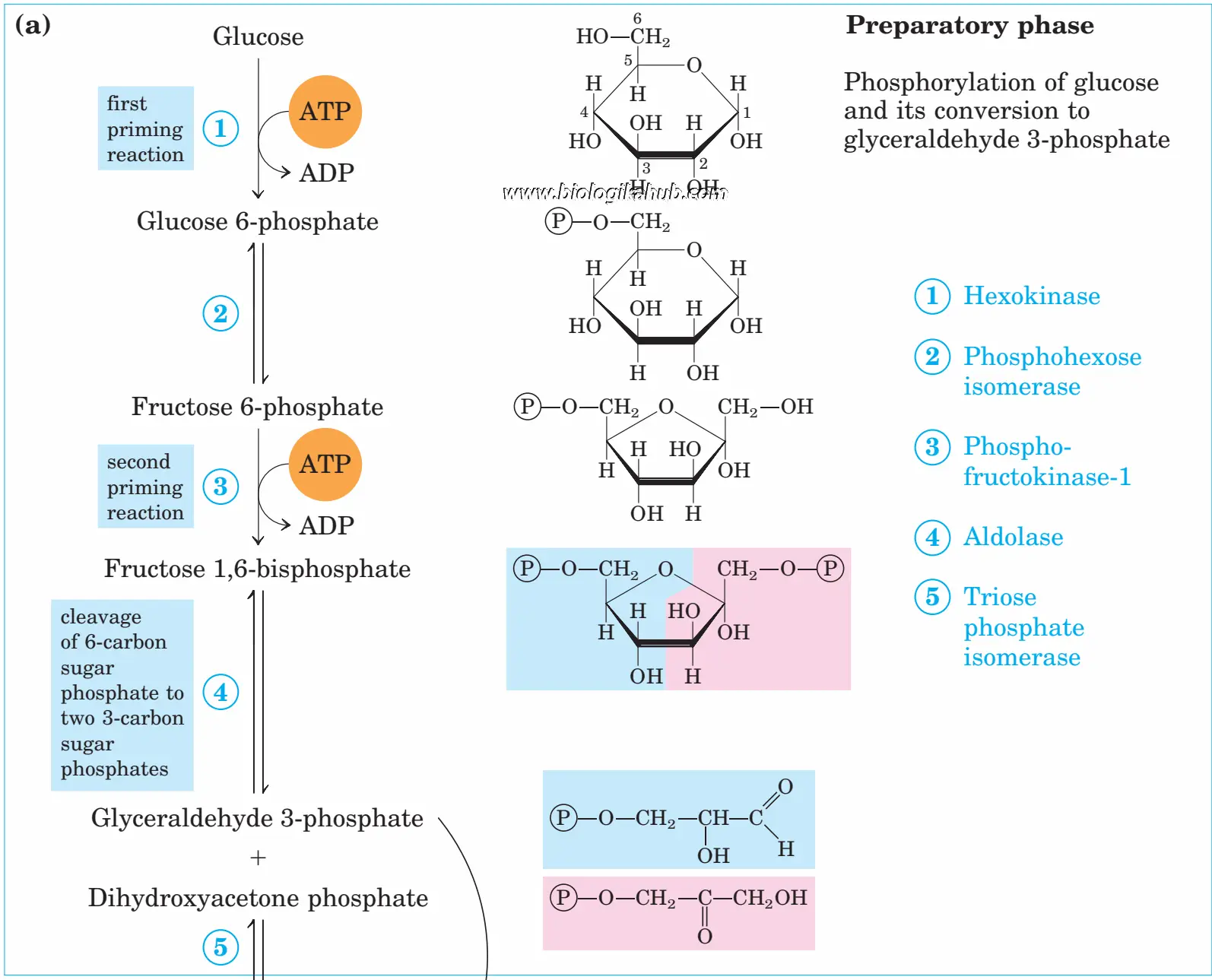
👉 Goal: Use ATP to activate glucose for breakdown.
- Glucose → Glucose-6-phosphate (G6P)
- Enzyme: Hexokinase (most tissues) / Glucokinase (liver, β-cells).
- Energy: −1 ATP.
- G6P → Fructose-6-phosphate (F6P)
- Enzyme: Phosphoglucose isomerase.
- Energy: None.
- F6P → Fructose-1,6-bisphosphate (F-1,6-BP)(Rate-limiting step)
- Enzyme: Phosphofructokinase-1 (PFK-1).
- Energy: −1 ATP.
- F-1,6-BP → Dihydroxyacetone phosphate (DHAP) + Glyceraldehyde-3-phosphate (GAP)
- Enzyme: Aldolase.
- DHAP ⇌ GAP
- Enzyme: Triose phosphate isomerase.
- Note: Now, all subsequent steps occur twice per glucose.
💰 2. Payoff Phase
👉 Goal: Generate ATP and NADH.
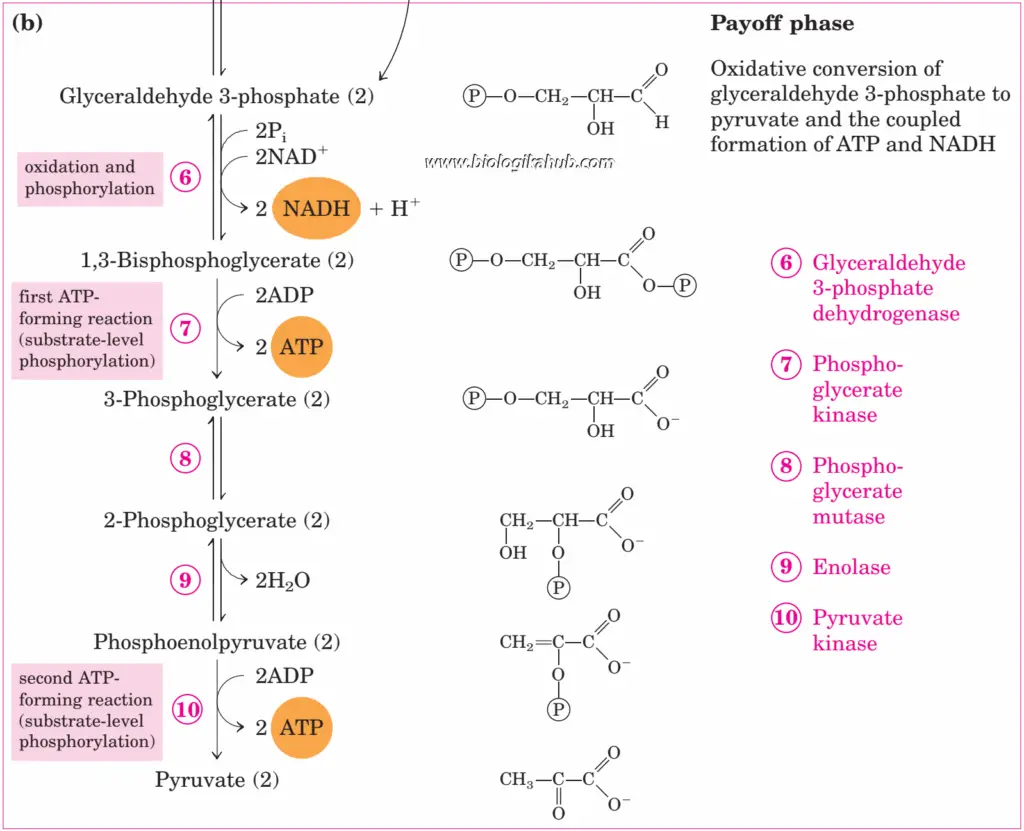
- GAP + Pi + NAD⁺ → 1,3-Bisphosphoglycerate (1,3-BPG) + NADH + H⁺
- Enzyme: GAP dehydrogenase.
- Product: 2 NADH per glucose.
- 1,3-BPG + ADP → 3-Phosphoglycerate (3-PG) + ATP
- Enzyme: Phosphoglycerate kinase.
- ATP Yield: 2 ATP (substrate-level phosphorylation).
- 3-PG → 2-Phosphoglycerate (2-PG)
- Enzyme: Phosphoglycerate mutase.
- 2-PG → Phosphoenolpyruvate (PEP) + H₂O
- Enzyme: Enolase.
- By-product: 2 H₂O.
- PEP + ADP → Pyruvate + ATP
- Enzyme: Pyruvate kinase.
- ATP Yield: 2 ATP (substrate-level phosphorylation).
⚖️ Energetics of Glycolysis
- ATP Consumed: 2 ATP (steps 1 & 3).
- ATP Produced: 4 ATP (steps 7 & 10).
- Net ATP Gain: +2 ATP per glucose.
- NADH Produced: 2 NADH.
- Net Water: 2 H₂O.
Overall Reaction:
👉 Glucose + 2 NAD⁺ + 2 ADP + 2 Pi → 2 Pyruvate + 2 NADH + 2 H⁺ + 2 ATP + 2 H₂O
♻️ Regulation of Glycolysis
Glycolysis has three irreversible control points (steps with highly negative free energy, essentially one-way reactions under cellular conditions). These serve as regulatory checkpoints that determine the rate and direction of glycolysis.
Glycolysis is tightly regulated at three irreversible checkpoints:
🔑 1. Hexokinase / Glucokinase (Step 1)
- Reaction:
Glucose + ATP → Glucose-6-phosphate (G6P) + ADP - Enzyme
- Hexokinase (location most tissue): High affinity (low Km), inhibited by G6P (feedback inhibition).
- Glucokinase (liver, β-cells): Low affinity(high Km), not inhibited by G6P.
- Regulation
- Hexokinase:
- Inhibited by its product (G6P).
- Ensures glycolysis does not proceed if downstream steps are saturated.
- Glucokinase (specialized regulation):
- Activated when blood glucose is high (after meals).
- Regulated indirectly by a glucokinase regulatory protein (GKRP) in the liver.
- Provides liver with ability to act as a “glucose buffer” for the body.
- Hexokinase:
- Role: Acts as a glucose sensor and buffer.
🔑 2. Phosphofructokinase-1 (PFK-1) (Step 3) (Rate-Limiting)
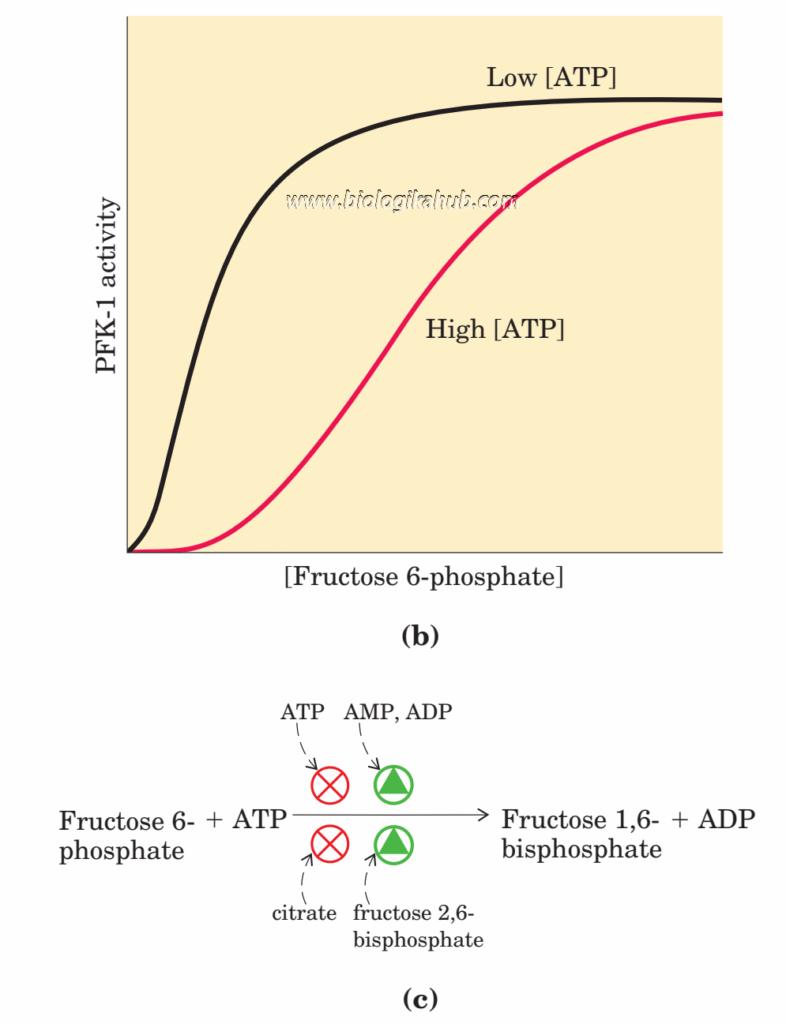
Figure: 3. Phosphofructokinase-1 (PFK-1) and Its Regulation
(b) Muscle PFK-1 activity is shaped by ATP levels, as seen in the substrate–activity curve. With low ATP, the enzyme shows a low K₀.₅ for fructose-6-phosphate, so it remains highly active even at modest substrate concentrations. Since K₀.₅ (Km) marks the substrate level needed for half-maximal velocity, this reflects efficient catalysis. Under high ATP conditions, the K₀.₅ rises significantly, giving a sigmoidal response that indicates reduced affinity and slower glycolysis.
(c) PFK-1 is further fine-tuned by multiple allosteric activators and inhibitors, providing a central checkpoint for glycolytic control.
- Reaction:
Fructose-6-phosphate + ATP → Fructose-1,6-bisphosphate + ADP - Enzyme: Phosphofructokinase-1 (PFK-1)
- This is the rate-limiting and most important control step of glycolysis.
- Regulation:
- ATP (signals high energy)
- Citrate (from TCA cycle, signals sufficient building blocks)
- H⁺ (low pH) – in muscle, prevents lactic acidosis.
- Allosteric Activators:
- AMP / ADP (signal low energy)
- Fructose-2,6-bisphosphate (F2,6BP) – most potent activator, produced by PFK-2.
- ↑ F2,6BP → ↑ glycolysis (even if ATP is high).
- Hormonal Control:
- Insulin ↑ PFK-2 → ↑ F2,6BP → ↑ Glycolysis.
- Glucagon ↓ PFK-2 → ↓ F2,6BP → ↓ Glycolysis.
🔑 3. Pyruvate Kinase (Step 10)
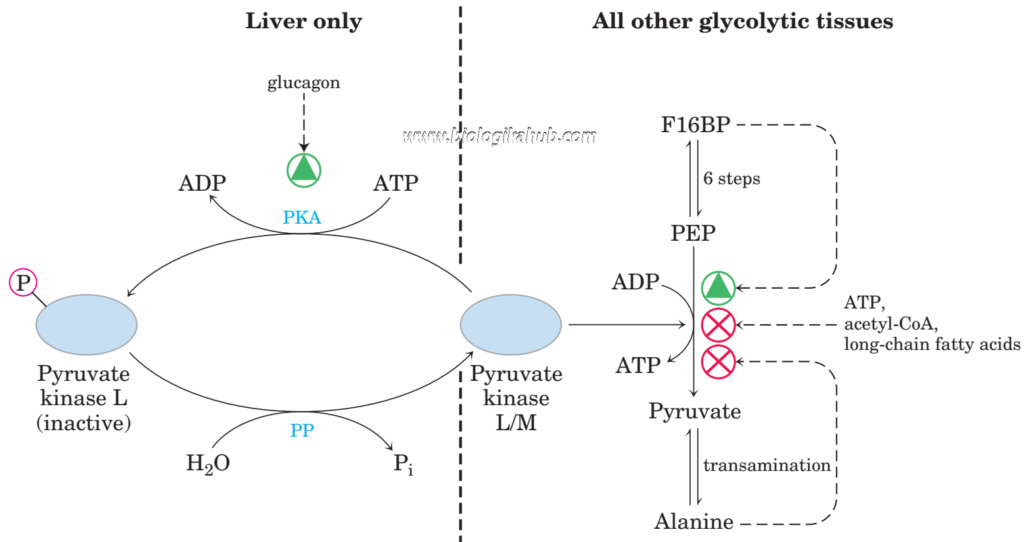
Figure: 4 Regulation of Pyruvate Kinase
Pyruvate kinase activity is finely tuned by both allosteric effectors and hormonal signals. It is inhibited by ATP, acetyl-CoA, long-chain fatty acids, and alanine (markers of energy sufficiency), while fructose-1,6-bisphosphate activates it through feed-forward stimulation. In the liver (L isozyme), glucagon via cAMP–PKA inactivates pyruvate kinase by phosphorylation, whereas dephosphorylation by protein phosphatase reactivates it when glucose is abundant. This ensures glucose conservation during fasting. In contrast, the muscle isozyme (M form) is not subject to hormonal phosphorylation control.
- Reaction:
Phosphoenolpyruvate (PEP) + ADP → Pyruvate + ATP - Activator: Fructose-1,6-bisphosphate (feed-forward activation).
- Regulation:
- Allosteric activator:
- Fructose-1,6-bisphosphate (feed-forward activation) – ensures pathway flows once committed.
- Allosteric inhibitors:
- ATP (high energy)
- Alanine (building block abundance, signals biosynthetic sufficiency).
- Covalent modification (liver):
- Glucagon → cAMP → Protein kinase A → phosphorylation of pyruvate kinase → inactive (slows glycolysis during fasting).
- Insulin → dephosphorylation → active.
🧠 Mind Dumps (Quick Recall)
🚀 Fast Track Summary
• Start: Glucose (6C).
• End: 2 Pyruvate (3C).
• Net Yield: +2 ATP, +2 NADH, +2 H₂O.
⚡ Mnemonics to Remember
Good –> Glucose
Girl –> Glucose 6-phosphate
Friend –> Fructose 6-phosphate
Fill –> Fructose 1,6-bisphosphate
Glass –> Glyceraldehyde 3-phosphate+
Daily –> Dihydroxy acetonephosphate
By –>1,3 Bisphosphoglycerate
3 PG–> PhosphoGlycerate
&
2PG–> PhosphoGlycerate
Play –> Phosphoenol pyruvate
Pingpong–>Pyruvate
💮 Key Enzymes (HK, PFK-1, PK) = “High Power Pathway regulators”.
⚡ Energy Steps:
o Investment → Step 1 & 3 (−2 ATP).
o Payoff → Step 7 & 10 (+4 ATP).
🚧 Regulatory Checkpoints
1. Hexokinase – entry control.
2. PFK-1 – master switch.
3. Pyruvate kinase – exit gate.ttractive Heading